Concerto C1 – Opere acusmatiche e audiovisive
Programma
totaleee / Andrea Laudante, Paolo Montella, Giuseppe Pisano-Riise
Non è un atlante di traiettorie algo-siderali (2025)
acusmatico
Antonio Forastiero
Layer (2023)
audiovideo
Rosario Grieco
DATA SHAPES (2024)
performance audiovisiva
orqan / Luca Mele, Giacomo Bassano
Digital Dust (2026)
audiovideo
Ali Hosseini
Delirium (2025)
audiovideo
Enrico Francioni
Simple_test (2023)
to Eugenio Giordani
acusmatico
Sebastiano Naturali
flusso_sonoro_1 (2025)
acusmatico
LasheK / Piero Poli, Gregorio Demaria, Dario Gatto, Danilo Gervasoni, Carlo Barbagallo, Roberto Laterza
Labirinto/Panopticon_PressioneRicorsiva (2025)
acusmatico
Selezione della call for works
Note di sala
totaleee — Non è un atlante di traiettorie algo-siderali
This is the second multichannel acousmatic music composed by the trio totaleee. Following the trio’s typical approach, this piece is the result of a collective creative act in which sonic materials are actively manipulated through ongoing exchange and unpredictable outcomes. The collaboration’s alchemy allows their work to develop in directions unfamiliar to their individual practices and to express itself through structures born from shared, horizontal processes.
Antonio Forastiero — Layer
This audiovisual work explores the concept of space. Different spatial dimensions alternate and overlap in an orderly and sometimes chaotic dialogue, giving rise to particularly complex spatial dimensions. Dynamic and articulate spatial dimensions are hidden within apparently static surfaces, which, underlined by particular multidimensional sound interweavings, emerge on the surface sometimes in an isolated manner, in other cases recreating elaborate visual interweavings.
Rosario Grieco — DATA SHAPES
Performance audiovisiva dal vivo che utilizza elementi generativi in tempo reale per rendere ogni esibizione unica. Immagina uno spazio virtuale popolato da dati, dove puoi vederli e ascoltarli, osservarne i movimenti: gruppi di informazioni che si aggregano e si disperdono, spingendosi nella massa fino a quando non puoi concentrarti su elementi specifici. Un’esperienza sensoriale: una finestra aperta su un ipotetico punto di scambio, o l’osservazione di un oggetto attraverso una lente d’ingrandimento, riuscendo a definirli nella loro concretezza per renderli più vicini e meno estranei. Una rappresentazione in cui suoni e immagini si susseguono rapidamente, le forme e i dati sembrano fluttuare in uno spazio vuoto e infinito, in un sistema in continua evoluzione dove si mescolano e cambiano costantemente forma, interagiscono tra loro e, lungo il percorso, si evolvono come per creare un tutto che li rende sempre più complessi.
orqan — Digital Dust
Improvisational live performance for one or more laptops by the duo orqan.
Through data bending techniques, the project explores the transformation of digital files into audible and visual material: temporary files and forgotten data are recontextualized as sound and image, generating immersive audiovisual environments in real time.
The performance investigates the post-digital condition of technology: audio generated from repurposed data drives reactive visual elements, creating a connection between abstract code and audience perception.
At the same time, Digital Dust reflects on the environmental and cultural implications of digital accumulation. Every day vast quantities of data are produced, stored and forgotten across clouds, hard drives and networks. By upcycling these residual files through custom Pure Data patches, orqan highlights the hidden materiality of digital waste, transforming technological residue into a live performative experience.
Ali Hosseini — Delirium
This work is dedicated to all souls, with a special reverence for women — to those whose voices were once silenced, whose brilliance was often veiled in shadows, or whose lives were erased by the tides of history.
To Alice Guy-Blaché
Enrico Francioni — Simple_test
Designed to recall the figure of the great electronic musician and pianist Eugenio Giordani, this work can be divided into “rooms” that host materials and gestures of various categories that return by typology in a cyclical way, but each time varied in content. The types range from synthetic sounds, to concrete material, to totally artificial elements. The gestures that we can identify are of the “continuum” type, but also of the “impulsive” category, or highly fragmented at other times. The materials include quotes from at least six electroacoustic works by Giordani, as well as other material, such as C-Pong.csd audio, musical performances, or human passages taken from a hypothetical, but real and unpublished library, put together by Giordani himself. Simple_test in the original 49-channel version has already been performed in the Sonosphere of the city of Pesaro (Italy).
Sebastiano Naturali — flusso_sonoro_1
It explores sound as a fluid and continuously transforming presence. The composition develops through evolving textures, rhythmic transformations, drones, and fragmented sonic gestures that alternate between moments of density and suspension. Recorded and synthetic materials are progressively reshaped through filtering, distortion, granular processing, and spatialization techniques, generating unstable sonic environments that oscillate between clarity and abstraction.
Conceived in both stereo and quadraphonic formats, the work emphasizes movement and spatial perception as fundamental compositional elements.
LasheK — Labirinto/Panopticon_PressioneRicorsiva
Acousmatic work by the LasheK collective, born from a larger project exploring creative agency in electroacoustic music. Human presence is partially withdrawn: the composition unfolds autonomously, as the system analyses pathways from previous performances through Markov-chain matrices, selecting and recombining materials from studio sessions, live recordings, and accumulated reprocessings. Archive, algorithm, and infrastructure act as compositional agents — shaping form, temporality, and sonic dramaturgy in a recursive environment where composition emerges from the interaction between human performers, computational systems, and autonomous processes of sonic transformation.
Biografie
totaleee
Trio of acousmatic music composers and laptop performers including Giuseppe Pisano-Riise, Andrea Laudante, and Paolo Montella. In their composition work, they use immersive audio technologies to create fictional environments of plausible and impossible nature. Their piece Non è un compendio di Etologia numerico-digitale (2023) was awarded the first prize at ISAC 2024, the Teresa Rampazzi Award at CIM XXIV (Turin 2024) and a CIME 2023 distinction.
Antonio Forastiero
Antonio Forastiero (1986)
Electroacoustic composer and sound designer. Graduated from the Conservatory of Potenza in electronic music and composition, he obtained a master’s degree in Sound and Entertainment Engineering at the University of Rome Tor Vergata. He attended masterclasses on electroacoustic composition and integrated audiovisual composition. He bases his compositional works on the elaboration of his electronically processed natural sounds, exploring their multiple tonal potentials. His research activity focuses on the relationship between sound and space for the development of particular immersive perceptual experiences. Since 2011 he has been a teacher of Music Technologies in musical high schools. His works have been selected in various international competitions.
Rosario Grieco
Rosario Grieco (Piano di Sorrento, 1973)
È un artista audiovisivo che lavora con ambienti video generativi e paesaggi sonori astratti. La sua produzione si concentra sulle modalità di interazione tra suono, luce e spazio per creare esperienze musicali visive dal vivo. Tra le principali esperienze: SOUND/IMAGE 2024 Festival, Londra | Live Cinema Festival, Palazzo delle Esposizioni, Roma IT | Milano Musica – Il Teatro della Voce, Teatro Gerolamo, Milano | Frischzelle Festival, Kunsthochschule für Medien Köln, Colonia.
orqan
orqan is an abstract music project formed in 2016, consisting of laptop musicians Giacomo Bassano (Novara 1991) and Luca Mele (Bordighera 1991). Their focus is to explore unconventional sound possibilities with the use and development of different devices, highlighting the interaction between them, processed in a constantly changing stream of sound. Live performances are rare but spread in different countries around Europe and Asia. They also released several albums through various labels around the globe.
Ali Hosseini
Multimedia composer and performer working across electroacoustic music, audiovisual art, and performative media. His practice combines Iranian microtonal traditions with contemporary composition, spatial audio, live visuals, and interdisciplinary performance. Winner of the ICMC 2026 Best Student Music Award, his work explores immersive relationships between sound, image, space, and perception.
Enrico Francioni
Graduated in Electronic Music (with Eugenio Giordani) and Double Bass (Fernando Grillo and Bruno Tommaso). He performed and recorded the Suite for double bass by Grillo. He is the author of the Csound code for the SOLO App inspired by Karlheinz Stockhausen’s homonymous work. As a composer he has been awarded in competitions and his works performed in international festivals. Professor in Double Bass at the Conservatory of Pesaro (Italy), founder of the “Fernando Grillo Project”, dedicated to the legacy of the great Perugian musician and performer.
Sebastiano Naturali
Sebastiano Naturali (2006)
Composer and student at the Conservatory of Potenza, where he studies Electronic Music and Classical Guitar. His work focuses on electroacoustic composition, spatialization, and sound transformation processes. He attended courses organized by IRCAM and was selected for ICMC 2026 with the fixed-media work flusso_sonoro_1.
LasheK
Collective composition project by Carlo Barbagallo (Siracusa, 1985), Gregorio Demaria (Rivoli, 1994), Dario Gatto (Domodossola, 1991), Danilo Gervasoni (Seriate, 1987), Roberto Laterza (Matera, 1996), and Piero Poli (Padova, 1998) that intends to revisit the concept of “open work” through a contemporary lens, using today’s technological tools to explore the relationship between individuality and social structures.
- 14 Ott 2026
- Expired!
- 18:30 - 20:00
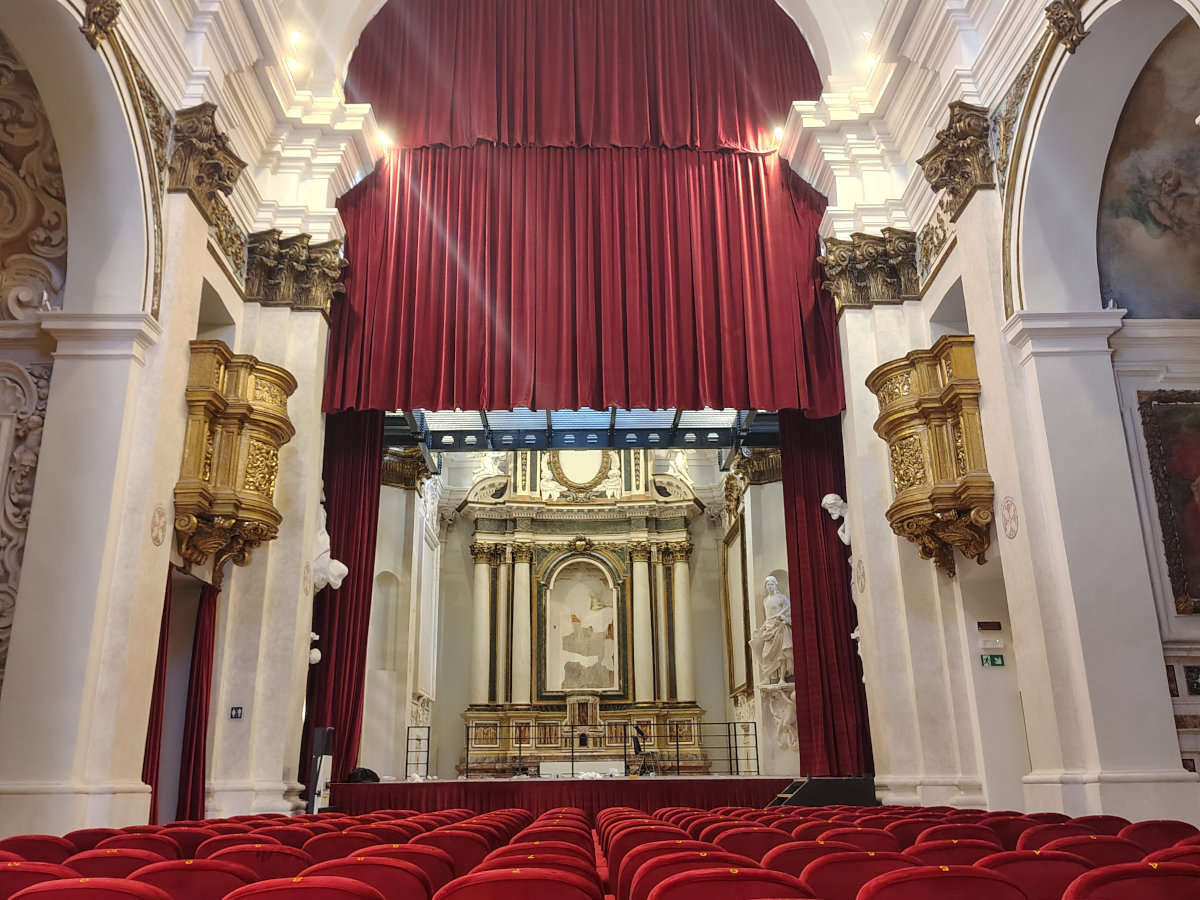
- Piazza S. Filippo, 24, 67100 L'Aquila AQ